Iran's decades of terror loom large as U.S. marks 25 years since 9/11
National News

Audio By Carbonatix
12:17 PM on Wednesday, September 9
Sarah Roderick-Fitch
(The Center Square) – Recent flare-ups in Iran serve as a reminder that the largest terror sponsor has wreaked havoc on the U.S. nearly 20 years before the terror attacks of Sept. 11.
Soon after President Donald Trump gave a speech on the Ellipse as part of the Steel Across America presented by Tunnel to Towers, the U.S. targeted five Iranian oil tankers attempting to attack U.S. warships.
Iran responded by attempting to launch missile strikes on American troops in Jordan – unsuccessfully.
During the president’s remarks Tuesday, he reaffirmed that “Iran cannot have a nuclear weapon,” as the conflict surpasses the six-month mark.
Trump told reporters Wednesday afternoon, as he was preparing to depart for Dallas, Texas, that he believes the war with Iran will “end immediately after the election,” noting the upcoming midterm elections in November.
“They can’t hold out any longer. They’re desperate to try and affect the election so that we can get a nice weak group of people in there and leave them alone and let them have their nuclear weapon. All they want is a nuclear weapon, and if they had a nuclear weapon, the whole world is in deep trouble,” the president said.
In addition to the midterm elections, Iran, the largest state sponsor of terrorism, looms large over the 25th anniversary of the horrific attacks that helped reshape America and the world.
While the U.S. retaliated against Al-Qaeda and the Taliban in Afghanistan, the war on terror spread to Iraq and Syria.
While the last troops pulled out of Afghanistan five years ago in a deadly withdrawal in August 2021, the American troops are expected to leave Iraq by Sept. 30, marking the end of more than two decades in the country.
Before, during, and after the wars in Iraq and Afghanistan, one country remained a constant threat in the region: Iran. The Islamic Republic has been blamed for the killings and injuries of hundreds of American troops through the use of Iranian-backed militants, known as the Quds Force, using improvised explosive devices.
Long before Sept. 11, 2001, Iran was seen as a greater threat to American forces in the region.
During the Lebanese Civil War, Hezbollah, a terror proxy of Iran, was responsible for the April 18, 1983, bombing of the U.S. Embassy in Beirut, Lebanon, killing 63 people and injuring 120.
The same year, the Marine Barracks in Beirut was attacked on Oct. 23, killing 242 and injuring 60 Americans. Up until the attacks of Sept. 11, 2001, the Marine Barracks bombing stood as the deadliest terror attack against the U.S., and the deadliest single-death toll for the Marine Corps since Iwo Jima during World War II in 1945.
Two Hezbollah terrorists hijacked a TWA flight flying from Rome to Athens on June 14, 1985. One American hostage, a U.S. Navy sailor, Second Class Petty Officer Robert Stethem, was murdered.
Thirteen years later, on June 25, 1996, a truck bomb exploded outside the U.S. military’s Khobar Towers in Dhahran, Saudi Arabia. The attack killed 19 U.S. service members, injuring 240 Americans. Investigators have pinned the attack on a Saudi branch of Hezbollah.
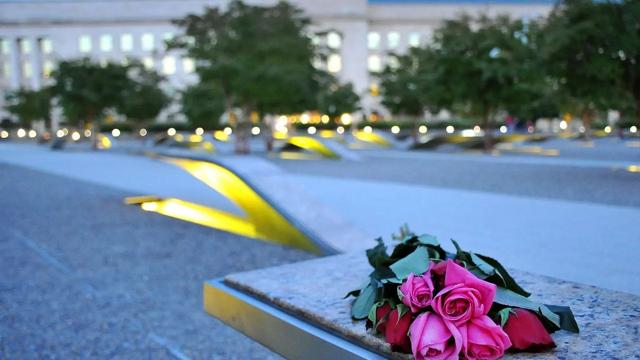
As the president is set to mark the 25th anniversary of Sept. 11 at the Pentagon Friday morning, he is expected to use the occasion to reflect on the 25 years of terrorism, and the role Iran has played in state-sponsored terrorism for nearly a half-century.