Supreme Court to define consequential gun rights in term
National News
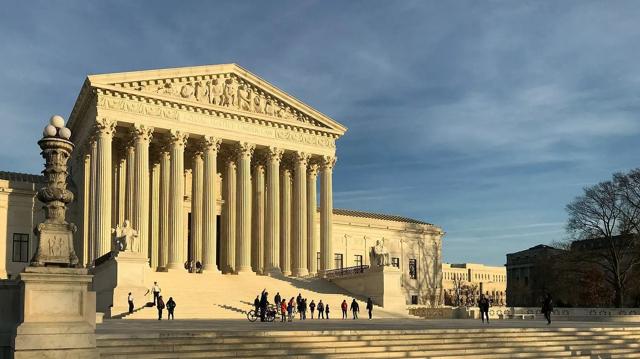

Audio By Carbonatix
2:03 PM on Tuesday, September 22
Andrew Rice
(The Center Square) - Legal analysts say the U.S. Supreme Court’s decision in an upcoming case on gun rights will have vast implications for Second Amendment protections across the U.S.
Law professors and legal analysts spoke at The George Washington University Law School’s Supreme Court Preview in Washington, D.C., on Tuesday. The professors highlighted Viramontes v. Cook County and Grant v. Higgins, consolidated cases challenging bans on semi-automatic weapons in Illinois and Connecticut.
Both assault weapons bans were pushed in the wake of mass shootings in the respective states. The laws ban the sale, delivery, manufacture, purchase and import of semi-automatic weapons including AR-15s.
The case is yet another test of precedent established in Bruen v. New York Rifle and Pistol Association. In that case, justices on the high court established that legislators must use history and tradition of the United States to justify depriving individuals of Second Amendment rights.
The high court previously rejected allowing individuals under domestic violence restraining orders from possessing firearms, allowed habitual drug users to possess firearms, and rejected a Hawaii law restricting concealed-carry permit holders from bringing firearms to restaurants, bars and other private areas open to the public.
“Nothing in the history or tradition of firearms litigation or legislation says that military features should necessarily be taken,” said Robert Cottrol, a professor of law at George Washington University.
Cottrol pointed to the Militia Act of 1792, legislation that required white men between the age of 18 and 45 to enroll in a local militia and buy their own military weapons and gear. He said this precedent will likely be used by the high court to strike down semi-automatic weapons bans.
“I would think that one of the best conditions of what the framers thought of military weapons was not even that they abandoned them, they required them,” Cottrol said.
Cottrol predicted justices on the high court would overturn the assault weapons bans in Illinois and Connecticut. However, he said the court’s logic in overturning the bans will be critical to future Second Amendment litigation.
The National Firearms Act of 1934 requires registration of fully-automatic weapons and rifles with the federal government. Since automatic weapons are used by the modern military, Cottrol said the outcome of the case would need to prevent automatic weapons from being allowed, in violation of the law.
“How do they draw a line and stay consistent with history and tradition but also preserve the idea that automatic weapons are different and are not within the ends of protection,” Cottrol said.
He also pointed out that the cases do not address large-capacity magazines. Cottrol said future litigation will have to determine what limits exist for weapons with large capacities.
“Assuming these cases go the way we think they are, what does the court do when faced with a magazine capacity limitation?”
Voter Registration
On Dec. 8, justices on the high court will hear RNC v. Mi Familia Vota, a case challenging Arizona’s laws that require proof of citizenship in order to vote in state elections. In federal elections, proof of citizenship is not required to vote.
In 2022, Arizona required individuals to obtain various documents to provide proof of citizenship in order to vote in statewide elections. The state registration form is separate from the federal registration form, since voters are not required to provide proof of citizenship to vote in federal elections.
Arizona sought to go about removing individuals from voter rolls who are not eligible, based on information from the state registration database. However, federal law prohibits states from removing individuals from voter rolls 90 days before an election.
“They will still be able to look for people who are not citizens but they would have to do it before the start of the 90 days,” said Alan Morrision, a professional lecturer in law at George Washington University.
Jury Limits
Legal analysts also discussed Kian v. Florida, a case to determine whether states across the country must be limited to 12 person juries. In Florida, juries can be made up of six people as long as the death penalty is not being considered.
Arizona, Connecticut, Indiana, Massachusetts and Utah also use six-member juries to handle cases that do not involve the death penalty. Renee Lerner, a research professor at George Washington University, said she anticipates that the court will uphold the requirement of a 12 member jury.
“If the court decides that it changes its rules about juries, what's required for juries, it means that every case on direct review would have to be retried at a minimum,” Lerner said.
She emphasized that states without the requirement would bear an enormous cost burden if they need to retry a wide array of cases from throughout the years.
“In cases that were decades old, you're asking witnesses to come back to the court,” Lerner said. “Witnesses have forgotten, they've died, you know, any number of other things. It's hard to assemble evidence again. That would have been a really tricky problem.”